


Moving Image in Architectural Space
Dolphin Brown’s moving-image works are created to exist in relationship with the spaces they inhabit. Movement, light, sound, scale, and duration become part of the experience of the architecture rather than simply occupying a wall.
From collector-scale works to larger architectural and site-responsive installations, each placement considers sightlines, proportion, surrounding materials, light, sound, and the rhythm of the space itself. The result is an artwork that becomes part of the identity of its environment and continues to unfold over time.


I’m an Austin-based moving-image artist exploring how movement, light, sound, and time can shape the experience of architecture and place. I create limited-edition video paintings and site-responsive installations for collectors and environments where art contributes to the identity of the space itself.
Seen Around the World — From Times Square to Venice
Dolphin Brown’s video paintings have illuminated iconic landmarks and international galleries — from the vibrant screens of Times Square, NYC to La Pedrera – Casa Milà, Barcelona — and beyond.
- London, UK
- Milan, Rome, Florence & Venice, Italy
- The Canary Islands
- Spain
- Across the United States
Times Square Showcase — Dolphin Brown’s work illuminating the heart of NYC
As Featured In
Selected press and publications featuring Dolphin Brown’s moving-image practice.


From Observation to Moving Image
The Image
Each work begins with footage I record from the natural world—light, water, botanical forms, reflections, and shifting surfaces. In the studio, the footage is slowed, layered, filtered, recolored, and recomposed until the original source moves between recognition and abstraction. Time becomes part of the composition, allowing the image to unfold gradually rather than resolve into a single fixed view.


The Sound
Sound is composed as part of the work rather than added as accompaniment. Depending on the piece, it may incorporate field recordings, plant-generated data captured through PlantWave, and digitally shaped ambient elements. Image and sound are developed together to influence how the work occupies and changes a space over time.
Placement & Site-Responsive Work

Step 1
Share the Space
Photographs, architectural drawings, dimensions, or a simple description of the site are enough to begin. Existing works are considered first, with attention to the character and requirements of the space.

Step 2
Develop the Placement
A placement visualization can be created to explore scale, orientation, and the relationship between the artwork and its surroundings. Display, sound, power, and installation requirements are resolved as part of the presentation.

Step 3
Acquisition & Installation
Once the placement is determined, the work is configured for the selected presentation and delivered ready for installation. Site-responsive projects are developed and priced according to the requirements of the space.
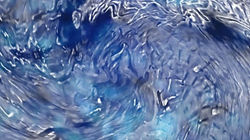
Abstracts explores how recorded fragments of the natural world can be transformed through movement, layering, color, and duration. Forms shift between recognition and ambiguity, allowing light, texture, and motion to become the primary structure of each work. Rather than resolving into a fixed image, the compositions remain in flux, changing gradually through time.
Abstracts
Featured works: Portal, Coalescence, Etchings, Aurora, Surface.
 |  |  |  |
|---|---|---|---|
 |
WHAT PEOPLE ARE SAYING
Questions You Might Be Asking
What is a video painting?
A video painting is a limited-edition moving-image artwork composed through light, movement, sound, and time. Rather than functioning as content displayed on a screen, the work is created as a complete artwork intended to become part of the experience of the space where it lives.
How is the work presented?
Each work is issued in a controlled edition and delivered fully configured for continuous playback. Connect power and the artwork begins automatically—no computer, app, media-player interface, or recurring setup required. Each acquisition is accompanied by a Certificate of Authenticity.
Can the work be placed at larger or architectural scale?
Yes. Works can be acquired in collector-scale presentations or developed for larger architectural and site-responsive placement. Scale, sightlines, light, sound, and installation conditions are considered in relation to the specific space so the artwork becomes integrated with the environment rather than simply added to it.